How The System Hits GenZ Twice — Work & Housing
-
Why Gen Z? Because when the youngest workers can’t get started, it tells you the whole system is broken.
Because they’re stepping into a market where:
rents are historically high
wages lag behind living costs
entry jobs are more competitive
affordability checks are stricter than ever
They are not the only group struggling — but they are the first generation entering adulthood where even a full-time job often fails to unlock secure housing.
-
There isn’t one solution because this problem was created by several systems failing at once: housing supply, wage growth, insecure work, planning delays, and rental practices. But there are realistic solutions.
1. Reconnect Wages to Housing Reality
If full-time workers cannot rent modest housing, the market is out of balance.
2. Build the Right Homes, Not Just Any Homes
Many cities build luxury units or investor stock while lacking genuinely affordable homes.
3. Fix Rental Gatekeeping
Many renters are blocked not by rent alone, but by screening systems.
4. Raise Standards in Shared Housing / HMOs
Shared housing is now a mainstream necessity, not a temporary fringe option.
5. Help First-Time Independence
Gen Z often need a bridge, not charity.
6. Change the Narrative
Too often, the response is “young people need to work harder.”
But many already are working hard.7. Less Co-Living, More Real Living
Young workers do not just need trendy communal lounges and branding.
They need the ability to settle, save, and build independence
Community should be a choice, not a substitute for affordability.
-
Build more homes.
Pay people properly.
Stop treating renters like suspects.
Raise standards.
Reward work again.Because the real crisis is not that people want too much, but rather, that full-time work should be enough for a decent start.
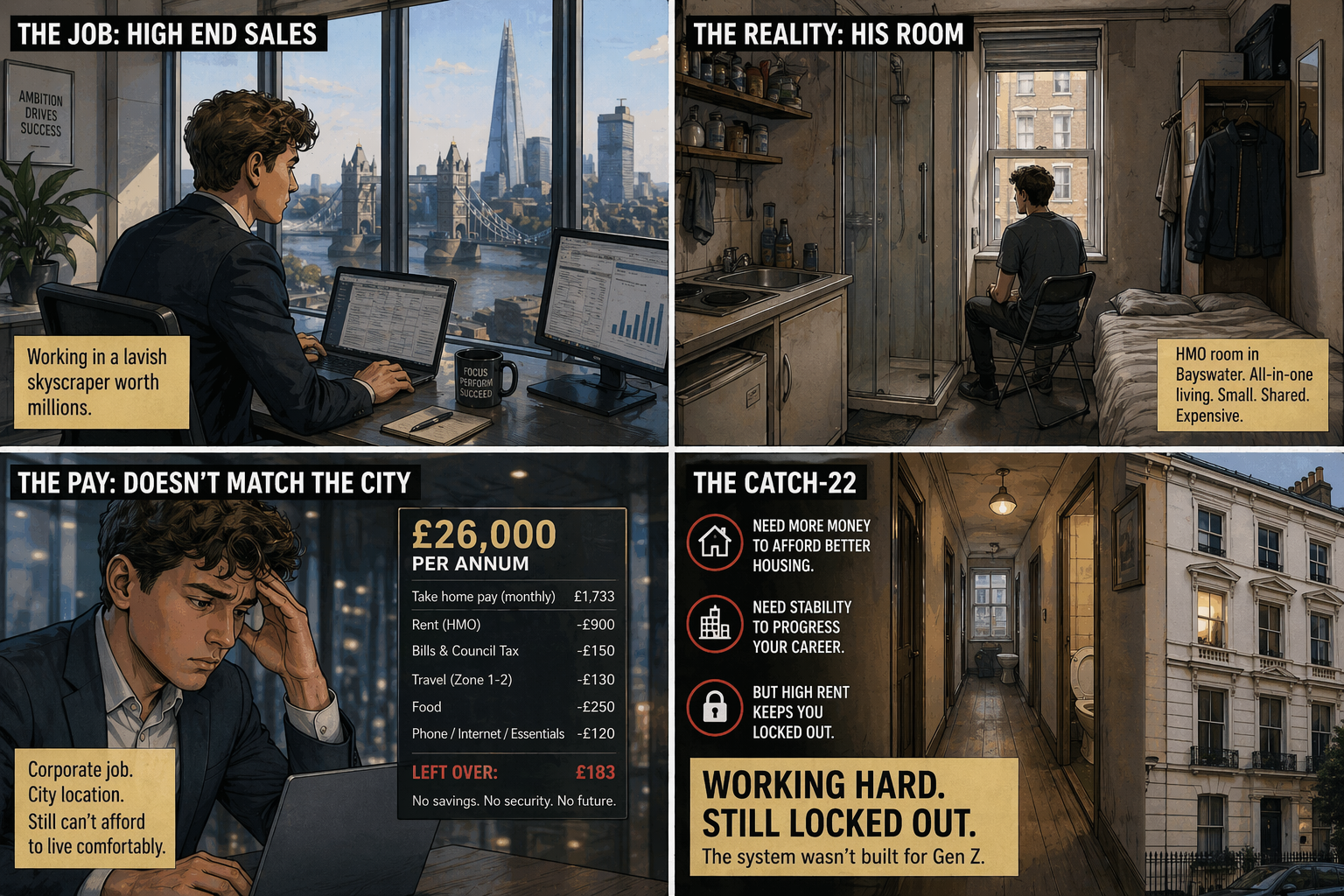
There’s a growing narrative that Gen Z needs to “work harder” or have “lower expectations.” But that completely misses what’s actually happening on the ground. This generation isn’t just facing one barrier — they’re being squeezed from two sides at once: the job market and the housing market.
1. The First Hit: A Broken Entry into Work
For many Gen Z job seekers, the traditional pathway into employment has quietly eroded.
Graduates leave university with degrees, qualifications, and often debt — only to find that entry-level roles are no longer what they used to be. Positions that once served as stepping stones are now:
Automated or partially replaced by AI tools
Consolidated into fewer roles with higher expectations
Requiring “experience” for jobs that are meant to provide it
Even those who do secure work often find themselves in low-paying starter roles, typically in the £24,000–£26,000 range in the UK. On paper, that might seem like a reasonable starting salary. In reality, it barely covers basic living costs — especially in major cities.
So before Gen Z can even think about stability, they’re already starting from a disadvantaged position.
2. The Second Hit: Locked Out of Housing
Now comes the second blow — and arguably the harsher one.
The rental market doesn’t operate on sympathy. It operates on formulas.
Most landlords and agencies apply strict affordability rules, often requiring tenants to earn 30 to 36 times the monthly rent annually. That means:
A very modest one-bedroom flat in London at £1,200/month
Requires an income of £36,000–£43,000+ per year
That’s far beyond what most entry-level workers earn. As a result, many Gen Z renters are pushed into:
Shared accommodation at inflated prices
Poor-quality housing with minimal standards
Long commutes from more “affordable” outskirts
Or staying at home — not by choice, but by necessity
And even shared housing isn’t the “cheap” option it once was. In many cases, a single room can cost £800–£1,000 per month — often for spaces that are overcrowded or poorly maintained.
The Catch-22: Work Doesn’t Unlock Housing Anymore
Here’s the real issue: getting a job no longer guarantees access to housing.
This is a fundamental shift.
In previous generations, employment — even at entry level — was enough to begin independent living. Today, that link is broken. You can do everything “right” — study, apply, get hired — and still be locked out of renting your own place.
A Generation Forced into Compromise
What does this mean in practice?
Gen Z is being forced to compromise on nearly every front:
Career choices (taking whatever pays, not what fits)
Living standards (accepting subpar housing)
Independence (delayed or completely out of reach)
And perhaps most concerningly, it normalises a system where basic milestones — a job and a home — are no longer connected.
Behind the Listings
Scroll through rental platforms, and you’ll see polished descriptions, buzzwords, and carefully framed photos. What you don’t see is the reality behind them:
The income thresholds that quietly exclude most young workers
The competition that turns renting into a bidding war
The mismatch between wages and rent that keeps widening
This isn’t just a housing issue. It’s a structural imbalance.
Gen Z isn’t failing the system.
The system is failing Gen Z — twice.
A healthy society lets young people begin.
Right now, too many are being asked to wait indefinitely.